This Is Me--2024 A to Z Theme

My A to Z Themes in the past have covered a range of topics and for 2025 the theme is a random assemblage of things that are on my mind--or that just pop into my mind. Whatever! Let's just say I'll be "Tossing It Out" for your entertainment or however it is you perceive these things.
Showing posts with label Persnickety Penman. Show all posts

Monday, July 4, 2011

Does Your Writing Have Fireworks?

         Happy 4th of July to all of us in the United States and I hope the rest of you around the world will join us in our celebration.


A photo of fireworks

          On Wednesday I'll be giving my thoughts about a book I recently finished reading.  It will be a somewhat negative review partly because I disliked the style of the writing, but also because of the rambling approach of telling the story (stories?).

           As I was thinking back on this book I began thinking about how writing is sometime similar to a fireworks display.  I also wanted to do a post today related to the Fourth of July.  Okay, so it's a gimmicky way to go, but this is my fireworks display for today.

           There are many types of fireworks ranging from simple sparklers and firecrackers to elaborate roman candles and multicolored skyrockets.  Fireworks may emphasize effects such as noise, smoke, fire, or floating materials, or may be a combination of any or all of these.  The display of the fireworks may be very basic for a solitary user or a small group of users, or they may be very elaborate on a massive scale for the larger audience.  Whatever the case, fireworks are intended to capture attention.

          Writers use literary effects to capture the attention of readers.  The fireworks of writing may come in the form of unique story approach such as twists or surprise endings.  Other attention getting devices may include vivid descriptions, clever metaphors, quirky style, or unorthodox punctuation.  Strong characters and realistic dialogue may be the forte of some writers while others may engage in rambling stream of consciousness or peculiar digressions into philosophical realms.

           Whatever the writer's approach may be, it will often become the trademark of that writer.   Some may pass off a writer's trick bag as gimmickry, while others will include it as style.  However, the writer should always make an attempt to be authentic and coherent.   All noise and dazzle might catch a readers attention initially, but will eventually wear thin if there is no substance.

             What kind of fireworks do you like to use in your own writing?   What fireworks--gimmicks, styles, or inclinations--annoy you most in the writing of others?     Will you be watching (or did you watch) a professional fireworks display on July 4th or do you like to buy your own fireworks and put on your own display at home?


**********

Monday, April 4, 2011

Controlling Characters

         Are you operating a puppet show or writing a story?  Becoming a control freak when it comes to writing your characters can leave them predictable and stereotypical--or shall we say boring. 

          Outlines and character sketches are good tools to use in shaping your main characters, but don't just stop there.  Give them history, aspirations, and motivation. The reader doesn't have to know every detail--only what's important to the story.  You should know your characters like you know those who are closest to you.  At the same time you should allow characters to make interesting choices and do unexpected things. 

          When Pinocchio was just a puppet he was lifeless and wooden.   When he became a real boy he became interesting.  Now, there was a story to tell.  Perhaps it's time to cut the strings from your characters and let them surprise you as they take on a life of their own.


***********

Monday, January 31, 2011

Practical Prompts


              The above photo shows four of the many boxes I have stored in the closet in my writing office.  There are many boxes in this closet, and in the office there are additional files of materials that I have accumulated over the years--mostly for the purpose of providing inspiration for my writing or as a record of things that I have written.

              There is probably little of any real monetary value stored in this room, but there is a wealth of ideas and thought provoking information to be found here.  News clippings and magazine articles, photos, scribbled thoughts, odd objects, and items of personal memories are all parts of my treasure.  Whatever I have kept because it somehow made me think of something to write, I have filed in a special place or tossed into a box or a drawer to be filed away at a later time. 

            The way I see it is that in my lifetime there is no way I could ever possibly run out of writing prompts.  If I find myself saying that I cannot think of anything to write about, what I really should be admitting is that I'm too lazy or not motivated to write at this moment.  Everything is a potential prompt for writing.  You just have to use your imagination and ask some questions.

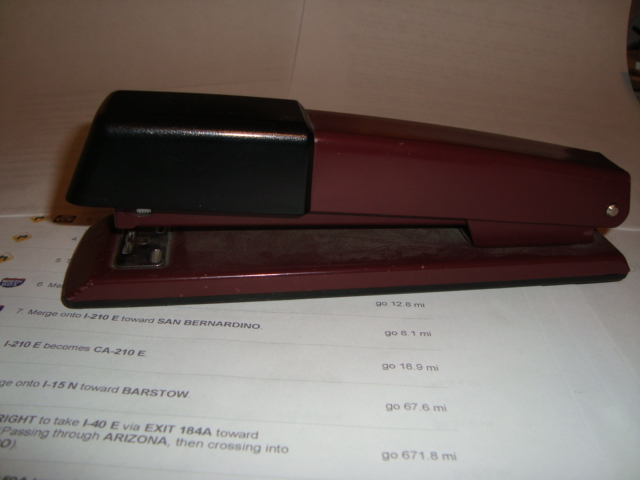
            Let me try a little exercise to illustrate how prompts are everywhere.  I'm at my desk and look to my left where I see a burgundy stapler.  Reaching over to pick it up, I realize it is a heavy metal stapler that could potentially kill somebody--there's a murder mystery here.   I look at the bottom and see it was made by the Bates General Binding Corporation.   I wonder what else they make and what is the history of this company?  Who designed the stapler, how is it made, and who made the decision to use the burgundy color.  This company is in Northbrook, Illinois.  What's it like there?  What is the history of this city?  The stapler was manufactured in Taiwan.  What is the factory like?  Who are some of the workers who handled this stapler while it was being manufactured and what are their lives like?

Potentially deadly stapler with a  long and complex history.

         These questions and contemplations could go on and on--I think you get the idea.   You could write an entire book about this stapler or come up with countless articles and stories about it.  And that was just the first thing I saw on my desk.   As cluttered as my desk tends to be, I potentially have a lifetime of writing at arms reach.

          Writing prompt exercises are fine, but where do those come from?  They come from another writer's imagination, that's where.  What are you doing to stretch your own imagination?   Look around you, pick common things up and examine them in detail.   Think about them and ask questions.  There are stories in everything, in everyplace, and in everybody.   It's up to the writer to make those stories come to life in an interesting way.
          
          The Blogging from A to Z April Challenge often elicits comments like, "I don't know if I can think of that many ideas for a whole month".    This is why it's a Challenge!   It's impossible to run out of ideas, though it's not inconceivable to run out of steam.  Last year I began to get a bit weary at the midway point of the challenge.  When I reached the letter "n" I decided that I could think of nothing to write about.  That's when the light bulb came on in my head.  I wrote a bit of flash fiction called "Nothing" that was rather well-received and this recharged my motivation.

          If writer's block is causing you to stumble, stop and take a breather.  Think.  Ponder.   Ask questions about why you are experiencing this barrier to progress.   Take a walk, listen to music, watch a movie, or talk to a child.  And if you need to do some exercises with writing prompts then let me suggest going for the practical prompts that are right there in your life.  What you write about is an extension of who you are.  Why shouldn't the writing exercises you do be a part of who you are as well. 

           How do you overcome writer's block?   Do you sometimes use prompts as writing exercise?   What are some of your favorite prompts?


--

Monday, December 6, 2010

Visualization

          Visualization is something that has become in more recent decades something that is part of New Age thinking.  It is often associated with prosperity or success philosophies which say if you picture something long enough and strong enough in your mind it will eventually come into being. 

            One of the early American proponents of this technique is  Wallace Wattles (1860–1911), who wrote The Science of Getting Rich.  His philosophy is rooted in some of the beliefs of the Hindu religion. Since then many success and self-improvement movements and books have continued in this similar school of thinking.  In the 1970s there were many new religious movements that embraced these thoughts.

              I am not here today to advocate any of the religious connections to visualization, but to approach the topic from a more logical viewpoint related to writing.  Although before proceeding I will say that in my own life there are things that I have visualized with a strong focus and they have come to pass.  This has been sometimes with good results and sometimes bad.  It is an illustration of be careful what you wish for because you might get it, but that's another topic for another time.  The real point that I'd like to make though is that the act of creative visualization usually has its results through logical explanations.  I'm not saying there can't be supernatural consequences to creatively visualizing something, but let me return to this aspect on my post tomorrow.

             Today let's look at the act of vividly visualizing as a part of the creative process of writing.  When I am reading something I try to picture what I'm reading.  This may be one reason that I often have a difficult time reading something that deals with concepts or things that are more related to thinking than seeing, or that is thinking in the sense of reasoning and contemplation.  This is me, and may be some you, and there are probably some complex reasons for this and I certainly wouldn't want to delve into those reasons here.  The bottom line is that I do better reading a story and story is my current topic.

            When I am writing, I am attempting to create a world, characters, and a series of events that the reader can become a part of.   In order to do this most effectively I see it as imperative that all of these things become real to me.  This must be done through vivid visualization. 

             Some writers take a very organized and detailed approach in creating outlines, character sketches, and other recorded details about aspects of the story with which they are dealing.  This is probably the most sensible approach.  My approach is much more internalized in my imagination.

             When I begin a story I start with a particular component which is usually focused on plot, character, or setting.  I start by thinking about it and organizing the basics in my mind.   Sometimes I will write down a few notes, but mostly I essentially start daydreaming or going through a process of visualization. 

              I will picture the characters and imagine as much as I can to make them real.  They become almost as real to me as the people I actually encounter in my life.   I can see in my mind in detail the places where the story takes place--I am there and I know what everything looks like.  The settings of my stories become places that are absolutely real to me. 

            Being unable to visualize what I am going to write is when inspiration is labored.  At that point I may have to look at a map or research what I want to write about.  Inability to understand inhibits being able see a clear image of my writing subject.

              Call it what you will, the ability to see the movie in my mind allows me to write the screenplay for whatever I am seeing.   Whether a short story or a  novel, I need to be able to drop myself in the midst of that story's world and become an observer in that world.  

               Success is when I find myself thinking about that world at random times during the day or relating my story to things I hear about or witness.   At times I may be experiencing life in a duality of existence--I am here where I am, but part of me is living in the level of my story.  In some ways this might sound a little crazy, but I think everyone in every pursuit does something very similar.  We are who we are and who we want others to think we are.

               My ultimate visualization victory is when I begin to dream the characters, setting, and story.  At that point I realize that the writing that I am working on has firmly placed itself into my subconscious and is now an absolute part of me.  Once I have achieved the ability to dream about my story I am often able to find solutions to aspects that have perplexed me, new understandings about characters or story concepts, or even new directions for the plot to take.

            What approach works best for you in creating your story and its elements?  Do you lean more toward a structured and practical approach?   If so, why do you think that works best?   How intensely do you resort to visualization?   What are the hazards of relying on vivid visualization?   If you are not a writer, do you use visualization in your own pursuit?

          Tomorrow I will be addressing the topic of creative visualization.    On Wednesday I will have a special post with a scheduled stop on Tamara Hart Heiner's book tour appearing on Tossing It Out.   Then on Thursday I'll be pulling something out of my hat.


.

Monday, October 25, 2010

Stephen Tremp's "BREAKTHROUGH": A Review


           When I first started blogging in September of 2009, one of the earliest blogs I came across and began following was that of Stephen Tremp, the author of Breakthrough.  Stephen often referred to his novel in his blog posts and discussed some of the technology that appears in the novel.  I was intrigued by the subject matter that Stephen discussed on his blog and about the concept of the story presented in Breakthrough.  And besides that, Stephen Tremp came across as one heck of a nice guy.

           Stephen has been valiantly promoting Breakthrough on mostly his own efforts, which takes some creative ingenuity and a strong positive attitude.  He has not only shown both, but took a rather incredible one step further when earlier this year he took the original version of Breakthrough off the market and released an improved revised version of the book.  This shows some real dedication to his craft and to his audience and he should be admired for that.

             In August I was one of the fortunate winners of a book give-away that Stephen held on his blog.  With the new version of Breakthrough in hand, I was now able to read this book that I had been reading so much about.  I will be honest.  I had no idea what to expect and my expectations were rather low.  Boy! was I ever wrong, and in this review I'll tell you why.

             In a nutshell, the story concerns quantum physics professor/adventurer Chase Manhattan who becomes involved in a quest to recover and destroy stolen technology that is to be used for nefarious purposes by a treacherous enemy group and to clear the technology's innovator, an MIT professor and researcher, who has been charged with a murder.  In a fast-paced story the action rapidly shifts back and forth between Boston, which is in the grip of a major snowstorm, and sunny Southern California. 

            A well drawn cast of characters drew me into the story.  Chase and his friends are likeable, with intelligence and humor.  They are not superheroes by any means and are flawed by weaknesses and bad judgment.  They are characters who seemed very real.  Likewise, the bad guys are villainous, but we see their very human qualities as well.

            The story is very well researched.   The settings are so well drawn that I felt like I was right there in the middle of the story.  The action scenes are so vividly written that I felt like I was watching instead of reading.  Cinematic is the best way I can describe Stephen's writing--the reading experience was almost like watching a movie.

            One good thing about this novel is that it is more of an amalgam of genres then strictly one specific genre.   Breakthrough would primarily fit in the action adventure category, but it also has elements of science fiction, suspense thriller, and romance.  Science fiction fans will enjoy the theoretical concepts of travelling through worm holes, but those who don't care for sci-fi will be pleased that the book does not become bogged down with complex technologies and theories.   The story takes place in today's world with ideas that have actually been studied by scientists.  

           There is enough action and romance to keep fans of those genres pleased.  Stephen also adds enough humor to keep the reader entertained.  In fact, the pacing of the novel is something that made the book such a pleasurable reading experience.  The chapters are short and the writing is succinct.  The reader is fueled with exciting doses of action, and then brought down for a breather that leads to the next action packed sequence.  The book has good writing by an author who demonstrates that he knows the formula for producing best-seller caliber writing.

           Breakthrough is a book that will please just about any audience.  There is very little profanity in the book and what does appear seems appropriate and not gratuitous.  Likewise with sex scenes, there is nothing graphic, but only very tastefully written sequences that are integral to the story.  There was nothing in the book that I can recall being offensive in any way.  I could recommend this book to anyone.

            Allowing that the book is part of a trilogy, I can accept the somewhat abrupt ending as the lead-in to the next novel, Opening, which I hope is not too long in coming--I am anxious to see where this story is going next.  Stephen gives us a preview of Opening at the end of Breakthrough.    Reading this sample filled me with anticipation about book number two.  It sounds like there are some very intriguing concepts still to come.

           My recommendation is buy this book!   It would also make a great gift for the book-lovers on your Christmas and birthday lists.  


Available from:


Visit Stephen Tremp's blog for additional information about electronic editions of the book and other details about the author and his work.

Stephen Tremp will be my guest on Tossing It Out on Tuesday November 9, 2010.

Tomorrow I will be starting my focus for the remainder of the week on Marvin (The Old Silly) Wilson and his new book Beware the Devil's Hug.  On Wednesday Marvin will join me on his tour for an interview.  On Thursday I will offer my review of his book.


.

Monday, October 18, 2010

Write What You Want to Know

           I'll probably never be a sports writer.  I just don't know enough about the subject and I'm not that interested in it.  There are many things that I'll probably never write about due to my lack of interest in them.  

          This brings to mind the adage of "write what you know".   I'd like to perhaps expand that to include "write what you want to know". This of course doesn't include journalistic type assignments where writers may be given assignments to write about topics that they may know nothing about and have to gather the required information in order to complete their articles. 

          What I am referring to here is the writer who works on their own incentive--the freelancer or the book author.  Many of us will probably concur that in order to write about a topic you don't necessarily have to be an expert on the topic, but you want to know enough to write convincingly enough to make you sound like you know what you are talking about.  This involves research about the subject matter.  It also involves an aptitude in writing within your chosen genre.

             Next month's NaNoWriMo challenge will require coming up with a topic and more than likely those of us writing will be writing about a subject that interests us in a genre in which we feel comfortable writing.  I am pretty sure I will not be writing a romance.   There may be romantic relationships in my story, but I probably wouldn't feel very adept at writing in the romance genre.

             Whatever subject I do decide to write about will more than likely be something that I find very intriguing.   I'm leaning strongly toward science fiction this go around, but it will probably not be anything highly technological or anything concerning other universes.  I prefer staying here on Earth and I would rather deal with philosophical or spiritual ideas than complex scientific concepts.

             The theory that I'm proposing is that most writers would prefer to write about either what they already know or about something they have a strong interest in learning more about.   If a writer is going to immerse themself into a fantasy world where they will be living and creating over a period of time, they need to maintain an enthusiasm for this world and the characters that inhabit this imaginary place (or real place in some cases).  Doing something you don't like can be a tremendous drain on energy and creativity. 

            Do you ever write about things in which you have little or no interest?    Have you ever started researching a topic that you thought you would not like and found it interesting enough to change your mind, or visa versa?  Are there any genres that you probably would avoid?    Would you ever push yourself into writing in an uncomfortable genre?
           

Monday, October 11, 2010

What Did You Say?

         Do you like to use impressive words or would you rather impress with your use of words? 

          I've always enjoyed building my vocabulary with interesting new words.  One of my favorite Reader's Digest features is the one about building one's vocabulary.  Spelling and vocabulary were two of my favorite subjects in school.  Like many of you, I like to have a good knowledge of words and to be sure that I am using the best and most correct words when I am writing.  However, I do find it somewhat annoying when I have to continually refer to a dictionary when I am reading.

         The average reading level of adults in the United States is typically cited as being somewhere between sixth and ninth grade, depending on what source is citing the statistic.  It's probably safe to say that the typical newspaper or popular magazine is pretty representative of the reading level of the average American.  Many, probably most, modern fiction books are written at a level that is easily understandable to the average middle school student.  

         Just the other day I was reading an excerpt of a scholarly treatise on a philosophical topic.  As I read--or tried to read--I couldn't help but shake my head in amazement at the lack of clarity due to the author's usage of obscure terminology.  This author was probably writing for a very specific audience that may have been very familiar with the terms, but as a layman I was not impressed.  This approach is common in academic writing, but could it be done better?

          Okay, bad example--academia is a world unto itself.  But thinking about literature or popular fiction, can an author capture a large readership with the appeal of large or uncommonly used words?   In the nineteenth century, many of the authors deemed as "the greats" seemed to be able to write in a more educated sounding style probably because their audiences were often more educated.   Later as the printed media began to reach a broader audience, the style and vocabulary became simpler.

         I don't have much of a problem with this "dumbing down" of literature because I want to read more quickly without having to stop to figure out what I've just read.   I'm more interested in straight-forward creative writing that gets the point across quickly and uniquely,  I'll take an uncommon metaphor or a precisely detailed description as long as it doesn't bog down my reading, unless I'm reading some artsy piece which I am expecting to bog me down.  There's nothing quite as bad as reading a fast paced action scene and having to stop to look up a word--give it to me straight and simple.

         That's the way I try to write.  Sure, I might throw in a more uncommonly used word now and then, but I try to do it in slow paced sections where thought is required anyway.  Pedantic language is good for pacing. When you want the flow to go, go, go then terse stacatto and fluid phrasing makes the read move with the action you are trying to depict. 

           Not many of the writers who are reading this are trying to write scholarly tomes.  If you are, I hope you receive a grant to pay your way.  If you try to write over the heads of your potential audience to show them how brilliant you are, then you may find that your audience will be very limited.  Most of the reading audience is not looking to be dazzled by erudition, but to be entertained by good writing that provides them with a rewarding experience of story and message.

          "My aim is to put down on paper what I see and what I feel in the best and simplest way."     — Ernest Hemingway  

               
         What's your take on this?   Do you make an extra effort to add more obscure or less often used vocabulary to your writing?    How would you classify your style of writing?   Who are some of the writers you admire the most?

Monday, October 4, 2010

Blog Boggled: New Blogging Schedule

             Readers have spoken.  For the past few weeks I have had a poll on this blog site to see which of my daily features were the most popular.  The results were as follows--with day, topic, and percentage of votes for the favorite topic:

Sunday Bible Study (20%)
Monday Blogging and Writing Topics  (68%)
Tossing It Out Tuesday  (50%)
Wednesday Human Interest stories and memoirs  (31%)
Thursday Debate Day  (31%)
Friday Mystery Topic  (43%)
Saturday Review and Preview  (11%)

         Percentages are over 100% because I had asked readers to pick the top three favorites.  I may have skewed things by including the day of the week since the percentages correspond with the most active days on this blog.  Still the numbers are pretty much what I had expected based on my analytics stats.

         The new schedule for Tossing It Out will eliminate the Saturday preview and review since that was pretty much of a throw away day anyway.  As I mentioned this past Saturday, there will still be occasional special Saturday posts for awards or whatever else special comes along.   These days will be unscheduled surprise days.   Also, the Sunday Bible Study will be taking a break as I re-evaluate what to do.  Alex J. Cavanaugh suggested that I might want to collaborate with other bloggers to create a separate Bible study blog where we can all contribute.  I'd be happy to discuss this with any interested parties.

         Here is the new schedule for Tossing It Out:

Monday:      Mostly Writing Monday is a day that may include Blog Boggled or Persnickety Penman features, reviews, or stories and poetry on some occasions.  And every now and then I might toss out a top favorites list.

Tuesday:   Tossing It Out Tuesday will continue with a mash up of Debate Day, my continued effort to get rid of stuff, and any other thoughts I want to toss out to readers to hear what you have to say.

Thursday:   The Thursday Mind Excursion will combine my current Wednesday human interest and memoirs with fiction and strange stories like I have been presenting on Fridays.  I might even experiment with Bible studies in a totally different way as suggested to me by Stephen T. McCarthy--I'll have to think on that one.

      
         I'll try the three day a week schedule for a while to see how that works and provide feedback to readers after the first month or so in case you're thinking about making your own changes.   And this is not to say surprise posts may occasionally pop up on other days. 

          Currently, I already have a couple of Wednesdays scheduled for book tours.  On Wednesday October 27 I am scheduled on Marvin Wilson's book tour for Beware the Devil's Hug.   Later, on Wednesday December 8 I am scheduled on Tamara Hart Heiner's book tour for her book, Perilous.

          As always, I would appreciate any comments or suggestions you can offer me.  And as the weeks go by, if there is anything you miss or would like to see more of, please let me know.  I do enjoy your ideas and you may have noticed that I do often use some of those ideas.

          I've tossed out my plan to you for your consideration, now how about you tossing me back your thoughts on anything I've said here.


Saturday, February 13, 2010

Before and After Valentine's Day


Happy Valentine's Day


        Yes, that's what I said.  You might not have expected that from me after my Thursday Debate Day post, but I'm still recognizing the spirit of the day and after all, I don't have to go into debt or spend frivolously to express the sentiment.  And, yes, I know Valentine's Day is tomorrow--I just didn't think it would fit in with my traditional Sunday Bible study.

       Which by the way, I don't think I ever mention my Sunday post.  Often I post something relevent to the Bible study that I lead at the church where I attend.  Other times I may just post something that is on my mind.  If you are interested in Bible studies please join in and feel free to comment.  After all, I'm not a Bible expert by any means and if I need to be corrected that's important.  I also like it when readers add their insights as well.

         Last Monday's first installment of the Persnickety Penman seemed a little low on readership and I'd still like to get some opinions if you would care to go back to it and leave a comment.  I plan to continue with this series on this coming Monday.  And on Tuesday, as I promised last week, I will be reviewing Stephen King's UNDER THE DOME, so if you've read it already please see if you agree with me.

         The rest of the week is up in the air.  After my self revealing post of last Wednesday, some readers commented that they wanted me to expound upon some of my answers, so I may use them for either my upcoming Wednesday or Friday posts for this week and beyond.  If you didn't read yesterday's post, The Chilhowee Grave Robbery , you may enjoy going back and checking it out.  An especially good  anonymous comment came late in the day--it was a rather spooky account and one can understand why the commenter wished to remain anonymous.  

           Don't forget your sweeties tomorrow!  Do you have any special Valentine's Day plans?


Monday, February 8, 2010

The Persnickety Penman: Difficult Definitions

               Today I'm going to delve into the act of writing.  On future Mondays I may return to the Blog Boggled theme because there are many more things to explore on the topic of blogging.  However, since the original focus of my Monday was to be on the act and the art of writing, I have decided to start a new series which I have alliteratively titled The Persnickety Penman.  Those of you familiar with my writing may have noticed that I have this thing for alliteration--I really like it.   I guess it's the poet in me.  If you are bothered by beginnings being with the same sound then I'm sorry. 

         In regard to the "Persnickety Penman" title, I just wanted to come up with something catchy and, of course, alliterative.  Who uses the word "persnickety" anyway?  In my view, it is a rather archaic word hailing from the Victorian Era and rather silly sounding to some of us these days--but this coming from a blogger who googles and uses widgets.  Persnickety is a rather fun word which means fastidious and overly fussy when it comes to details.  This is rather ironic since I sometimes tend to totally disregard rules of grammar and punctuation.  Who says we can't experiment as long as most people know what we are saying?

        Then there is the term "Penman".  How inappropriate is that nowadays?  Shouldn't it be something more like "keyboardman"?  Sure, I know that some writers still like to scrawl out their works in longhand, and it does seem rather romantic to idyllicly sit on a park bench or under a tree in the woods writing one's words. But do you honestly plan on submitting your work in that form? 

       And then there's the feminist issue of words ending in "man".   We can't say "penperson"--though I like the alliteration---because it ends with the male noun "son".  How about "penone"?  That obviously doesn't work because spellcheck will think you're talking about a flower, just looking at the word would make you want to pronounce it "pee-none", and if you did pronounce it "pen-one" then people might think you are mispronouncing a member of the bird family that lives in Anarctica.  So maybe penentity?  That might deserve a prison sentence.  Which makes me wonder why more convicts aren't writers?

         So once again, here in a blog post I've changed horses in the middle of the stream, which by the way is a rather peculiar idiom that sounds more archaic than persnickety.  But I did start out to write about something totally different than where this blog entry is heading.  I get that way sometimes--I just start writing off the top of my head and wander from one thing to the next.  I suppose you could say that I change horses in the middle of the stream of consciousness.  

         Hopefully next Monday I'll go back to the topic I started to write about-- topicality in one's writing --and after looking at the beginning of this sentence I think I'll just move on to one closing topic.

         One thing that always makes me stop to think when I write is proper usage of gender neutral third person pronouns.  As I was growing up--when men were men and women were housewives (just a joke--don't get mad at me dear ladies)--I was taught that the proper gender neutral third person pronoun was he or him.  Then as I got into college in the 1970's we were encouraged to use the ridiculously awkard he or she and him or her.  This pronoun choice sounds silly and can get annoyingly redundant.  A study at Johns Hopkins University suggested that the term yo was becoming a popular third person gender neutral pronoun.  Yo's not gonna sell me on that one.  All I want to know is who is that linguist and what was yo thinking?

         My personal preference is the disputed usage of the pronouns they or them.  To me they are the only pronouns that sound natural and are comfortable to use in third person singular gender neutral.  Why do we need to make up a word when we've already got one that is commonly used?  I think most of us use they or them when referring to a general third person in our everyday speech.  Me?  I like to write like I speak and I'm going to continue using they and them until the pronoun police come an put me in the penentity.

         What about you?  Which third person pronoun do you prefer when gender is generalized?  Does alliteration in prose bother you?  Just tossing it out there so you can juggle it all in your mind a while and then toss it back.